Common Mistakes, Exam Testing & Practice Questions
Common Mistakes That Cost Marks
In O-Level Electricity, many students lose marks either because they do not know the formula, or their answers do not match how examiners award marks.
Common Mistakes in O Level Electricity
- Mixing up current and voltage.
- Incorrect or incomplete circuit symbols are also penalised. Ammeter placement, voltmeter connections, and switch symbols must be drawn accurately to score.
Marks are often lost through ignoring units or using inconsistent units, such as mixing milliamperes with amperes without conversion.
Finally, some answers give a numerical value without linking it back to the question context. Examiners expect students to state what the value represents and how it relates to the circuit.
At O-Level, examiners reward clear explanations, not just correct numbers.
Electricity and ElectroMagnetism
Potential Difference (Voltage)
Potential difference provides energy to move charges.
Students should know:
Voltage is the energy transferred per unit charge
Voltage is measured in volts (V)
Voltage is shared in series circuits
Voltage is the same across parallel branches
Questions often require students to explain energy changes rather than state voltage values.
Electromagnetism
Electric current can produce magnetic effects.
Students should know:
A current-carrying conductor produces a magnetic field
The direction of force can be found using Fleming’s Left-Hand Rule
Increasing current or number of coils strengthens an electromagnet
Questions frequently test direction rules and cause–effect relationships.
Fleming’s Left-Hand Rule
Flemings left hand rule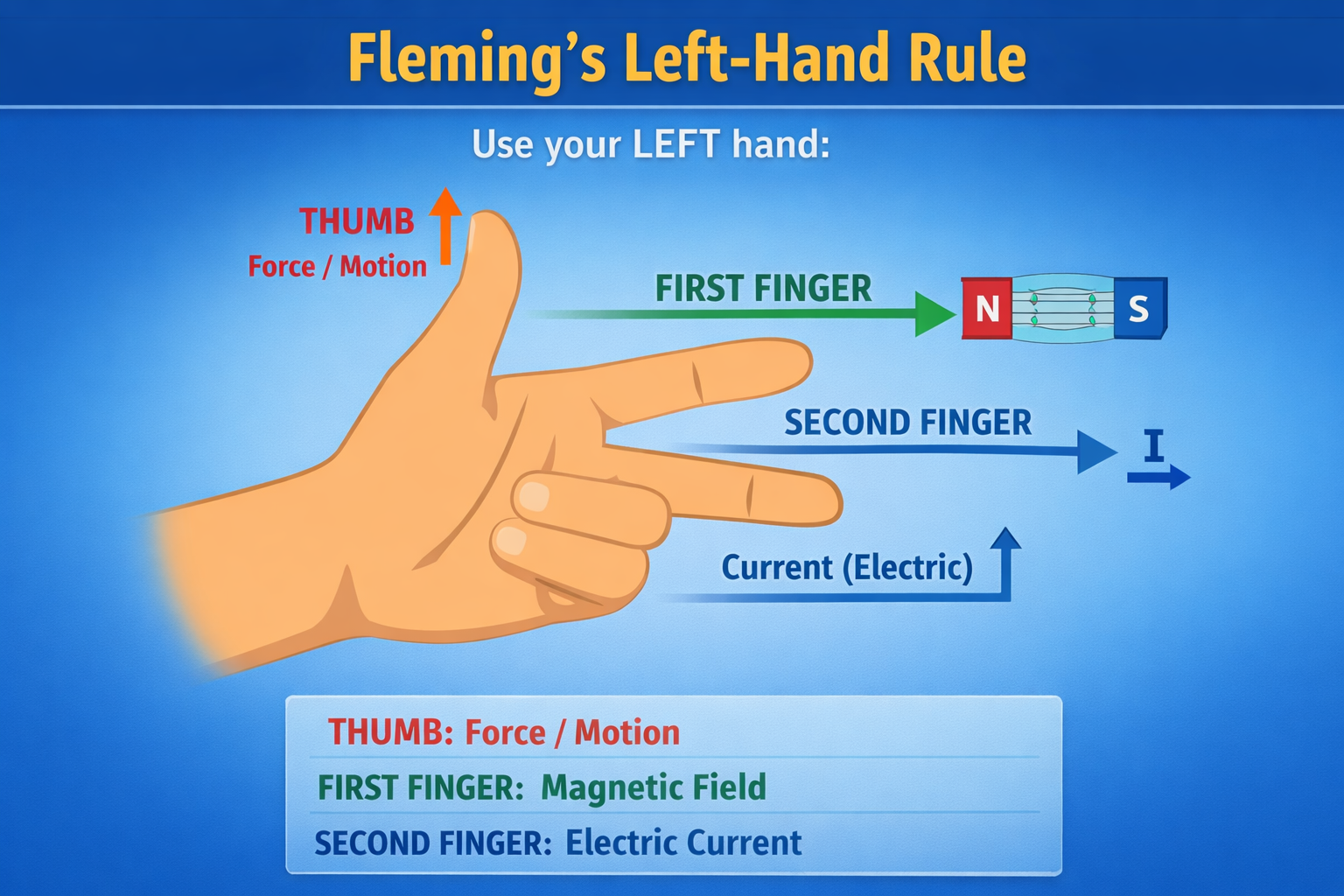
This rule predicts the direction of force on a current-carrying conductor.
Students should know:
First finger represents magnetic field direction
Second finger represents current direction
Thumb represents force or motion
Questions often require correct application of the rule rather than naming it.
How Electricity Is Tested in Exams
Electricity questions appear in several forms across the paper.
Structured calculation questions typically require students to apply formulas such as
V = IR or P = IV in a step-by-step manner.
Conceptual explanation questions test understanding of ideas like potential difference, current flow, or energy transfer, often without heavy calculation.
Data-based questions require students to interpret tables or graphs, identify patterns, and explain relationships using correct physics terms.
Practical-related reasoning questions may ask students to explain observations, suggest improvements to an experiment, or identify sources of error in circuit setups.
High-scoring answers usually:
- State the relevant principle clearly
- Apply it step by step
- Use correct scientific terms
- Refer directly to the circuit, diagram, or data given
How to Study Electricity Effectively
To improve in Electricity, students should actively engage with the topic.
Drawing circuits while studying helps reinforce how components are connected and how current flows, instead of passively reading notes.
Practising explanations in words is essential. Being able to describe what happens in a circuit is just as important as using equations.
Comparing similar questions allows students to spot common patterns in how Electricity is tested.
Checking mark schemes helps students understand how explanations are phrased and what examiners are looking for.
Understanding Electricity is about connecting ideas, not memorising equations.
O-Level Practice Questions (Try Before Checking Answers)
Q1. Define electric current.
Q2. State the relationship between current, voltage, and resistance.
Q3. A current of 0.5 A flows through a resistor connected to a 6 V battery.
Calculate the resistance.
Q4. Explain why a voltmeter is connected in parallel across a component.
Q5. In a series circuit, what happens to the current at different points? Explain briefly.
Q6. Two identical bulbs are connected in parallel.
State one advantage of this arrangement.
Q7. A student connects an ammeter in parallel with a bulb.
Explain why this is incorrect.
Q8. Calculate the electrical power dissipated when a device operates at 12 V with a current of 2 A.
Q9. A circuit uses a fuse rated at 3 A.
Explain the purpose of the fuse.
Q10. In an experiment, the current increases when resistance decreases.
State the law that explains this relationship.
Answer Key
A1. Electric current is the rate of flow of electric charge.
A2. Voltage is equal to current multiplied by resistance (V = IR).
A3.
R = V ÷ I
R = 6 ÷ 0.5
R = 12 Ω
A4. A voltmeter measures potential difference across a component, so it must be connected in parallel to compare the energy per charge on both sides.
A5. The current is the same at all points in a series circuit because there is only one path for charge to flow.
A6. If one bulb fails, the other bulb can still remain lit.
A7. An ammeter has very low resistance. Connecting it in parallel can cause a large current to flow and damage the meter.
A8.
P = IV
P = 12 × 2
P = 24 W
A9. The fuse melts when the current exceeds 3 A, breaking the circuit and preventing damage to components.
A10. Ohm’s Law.
Excel in Physics with PivotPhysics Tuition
PivotPhysics offers specialised Physics tuition for O-Level, A-Level H1/H2, and IP Physics students in Singapore.
With a proven track record, our lessons combine clear concept teaching, real-life applications, and exam-focused techniques to build a strong foundation and boost confidence in Physics.We also provide Physics Practical Lab Coaching aligned with SEAB standards to help students excel in their Paper 3 components.
👉 Contact us today to find out how PivotPhysics can support you or your child in achieving excellence in O-Level, A-Level, or IP Physics.