Most H2 Physics students spend the bulk of their preparation on the written papers. The practical, Paper 4, tends to get whatever attention is left over, usually in the final weeks before the A-Levels.
The practical is also the paper most students underestimate. Paper 4 is worth 20% of your H2 Physics grade, and under the 2026 H2 Physics syllabus (9478), it tests something most students have never deliberately practised: processing and analysing experimental data in a spreadsheet.
What the H2 Physics Practical Paper Assesses
Under syllabus 9478, the A-Level H2 Physics examination comprises four papers, with the practical being Paper 4. The paper runs for 2 hours 30 minutes, carries 50 marks, and counts for 20% of your final H2 Physics grade.
Paper 4 is split into two sections. You are given 1 hour 15 minutes of access to the apparatus for each, and you are told which section to attempt first. No textbooks, notebooks, or reference materials are allowed in the examination.
The whole paper assesses experimental skills, which the syllabus groups under Assessment Objective C. Nothing on Paper 4 rewards recall for its own sake. Every mark is tied to something you do: a measurement you take, a graph you plot, a conclusion you justify, an error you identify.
The Four Skill Areas, and Where Marks Are Lost
Paper 4 assesses four skill areas. Two of them account for almost all the marks.
- Planning (P) carries a 4% weighting.
- Manipulation, measurement and observation (MMO), presentation of data and observations (PDO), and analysis, conclusions and evaluation (ACE) together carry 16%.
Here is what each asks of you, and where students consistently lose marks.
- Planning asks you to design an investigation: define the problem, give a clear procedure, describe how the data leads to a conclusion, and assess the risks. Students lose marks here by writing a procedure that cannot actually be carried out, or by omitting the step that converts raw readings into the quantity the question asks for.
- Manipulation, measurement and observation: handle various apparatuses and record what you see accurately and with the appropriate precision. It is a skill that cannot be learned from a textbook. Students who have only read about a potentiometer circuit or a cooling-curve setup, but never adjusted one, take too long, misread scales, and miss anomalous readings they should have questioned.
- Presentation of data and observations: how you record and display your data. Are tables set out correctly, quantities given an appropriate number of decimal places, or trends noted clearly? Marks go missing when significant figures are inconsistent, when column headings omit units, or when a graph is plotted without thought to scale.
- Analysis, conclusions and evaluation: interpret the data, draw conclusions, and identify the errors and limitations that affect your results. Students often find this section the hardest as it requires not only naming the source of an error, but also explaining how it affects the result and what you would do to reduce it.
The 2026 Change: Analysing Data in a Spreadsheet
The most significant change in the 2026 H2 Physics syllabus is the way data analysis is assessed. Paper 4 now requires you to process and analyse data using spreadsheet software, and each candidate sits the paper with a computer and a quick reference guide.
You are expected to be able to:
- Import a CSV data file and enter your own experimental readings
- Write and copy formulae across cells, including logarithms, exponentials, and trigonometric functions
- Plot a labelled line graph, set the scale on both axes, and add a line of best fit
- Display the equation of the trendline
- Find the area under a curve and the gradient at a point on a curve
None of this is difficult once you have practised it, but most students have not. They have plotted graphs by hand for years and assume the spreadsheet version is the same task with a mouse. Spreadsheet fluency builds through steady practice over a realistic stretch of time, not a run-through the week before the exam.
What Topics Does the Practical Cover?
The practical is not tied to a fixed list of topics. Any experiment on Paper 4 draws on physics you have already studied. What is being tested is your skill, not a specific setup.
In practice, experiments cluster around a few areas because of the apparatus involved. Electrical experiments using ammeters, voltmeters, resistance wire, and potentiometers are common. So are mechanics experiments involving springs, pendulums, and oscillations, and thermal experiments using calorimeters and thermometers.
See the apparatus list published with the 9478 syllabus below.
| Electrical | Mechanics and General Items |
|---|---|
| ammeter (analogue): f.s.d. 500 mA and 1 A | pendulum bob |
| digital ammeter – minimum ranges: 0–10 A reading to 0.01 A or better, 0–200 mA reading to 0.1 mA or better, 0–20 mA reading to 0.01 mA or better, 0–200 µA reading to 0.1 µA or better (digital multimeters are suitable) | stand, boss and clamp: × 3 (rod length: 2 × 60 cm, 1 × 90 cm) |
| voltmeter (analogue): f.s.d. 3 V | G-clamp × 2 |
| digital voltmeter – minimum ranges: 0–2 V reading to 0.001 V or better, 0–20 V reading to 0.01 V or better (digital multimeters are suitable) | pivot |
| galvanometer (analogue): centre-zero, f.s.d. ±35 mA, reading to 1 mA or better | pulley |
| power supply: 12 V d.c. (low resistance) | tuning forks (set of 8 pc): (1 set per 4–6 candidates) |
| cells: 2 × 1.5 V with holder, 2 V | newton-meter: 1 N, 10 N |
| lamp and holder: 6 V, 300 mA; 2.5 V, 0.3 A | rule with millimeter scale (2 × 1 m, 1 × 0.5 m, 1 × 300 mm) |
| rheostat: max resistance: 22 Ω, rating: at least 3.3 A | digital micrometer screw gauge (1 per 4–6 candidates) |
| switch | digital vernier calipers (1 per 4–6 candidates) |
| jockey | stopwatch (reading to 0.1 s or better) |
| leads and crocodile clips | protractor |
| wire: constantan 26, 28, 30, 32, 34, 36, 38 s.w.g. or metric equivalents | balance to 0.01 g (1 per 8–12 candidates) |
| bare copper wire: 18, 26 s.w.g. | beaker: 100 cm³, 2 × 250 cm³ |
| magnets and mounting: 2 × magnadur magnets plus small iron yoke for mounting, 2 × bar magnets | Plasticine |
| compasses: 2 × small | Blu-Tack |
| wire cutters | |
| springs | |
| spirit level (1 per 4–6 candidates) | |
| stout pin or round nail | |
| optical pin | |
| slotted masses: 1 each 5 and 10 g; 2 × 20 g; 4 × 50 g; 1 × 50 g hanger |
| Thermal | Mechanics and General Items (continued) |
|---|---|
| long stem thermometer: –10 °C to 110 °C at 1 °C intervals | slotted masses: 4 × 100 g; 1 × 100 g hanger |
| metal calorimeter | cork |
| measuring cylinder: 50 cm³, 100 cm³ | string / thread / twine |
| plastic or polystyrene cup 200 cm³ | scissors |
| means to heat water safely to boiling | adhesive tape |
| heating mat | card (assorted sizes) |
| stirrer | sand and tray |
| wood (assorted sizes, for various uses, e.g. support) | |
| bricks: 2 × (approx. 22 cm × 10 cm × 7 cm) |
H2 A-Level Physics Practical Tips That Actually Move Marks
Preparing for the physics practical looks different from preparing for the written papers. A few things consistently separate students who do well.
- Handle the real apparatus under timed conditions. Familiarity is the single biggest factor in marks, and it cannot be built by reading. Set up circuits, adjust them, and take readings against a clock.
- Practise the spreadsheet workflow separately. Import a dataset, plot it, fit a trendline, and extract the gradient and intercept until the steps are second nature.
- Treat error analysis as its own topic. Learn to state a source of error, explain its effect, and suggest how you would improve your experiment designs.
- Rehearse planning answers. Write full procedures for unfamiliar investigations, then check whether someone else could actually follow them.
Why Hands-On Practice Is the Part Most Students Skip
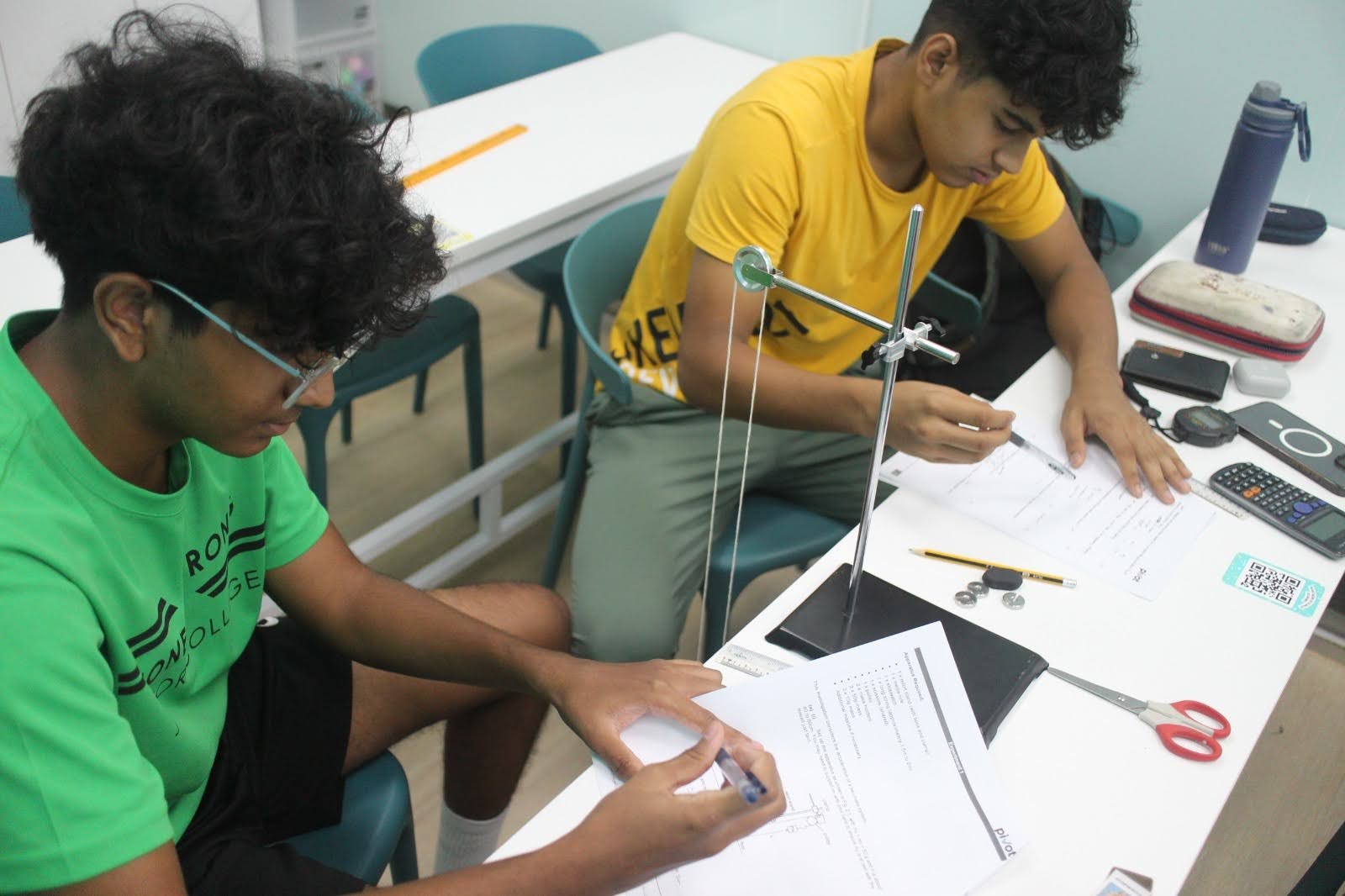
Every skill on Paper 4 improves with the same thing: time spent handling real examination apparatus, not just revising notes. Hands-on time is also what students have the least access to. School practical sessions are shared, rushed, and often focused on completing the experiment rather than sharpening technique. And you cannot set up a potentiometer circuit or run a cooling-curve experiment at your kitchen table.
We built the Pivot Lab for this reason. It is a dedicated Physics laboratory equipped with the apparatus used in A-Level practicals, and the only such facility at a Physics tuition centre in Singapore. The Pivot Lab gives you the hands-on repetition that makes tuition worth it.
Prepare for Paper 4 With the Right Support
If you are preparing for the A-Levels and the practical is the part you have thought about least, it is worth addressing before it becomes a scramble in the final weeks.
We offer H2 Physics tuition for J1 and J2 students across five locations in Singapore, with dedicated practical coaching in the Pivot Lab using real examination apparatus. If you want to see how our approach to physics tuition in Singapore works, a free trial class is the easiest way to find out. Classes run at Jurong East, Novena, Bukit Timah, Parkway, and Hougang.