Physics tuition in 2026 is no longer about covering more questions or memorising more formulas. What determines success now is whether students can interpret unfamiliar situations, explain reasoning clearly, and apply core principles flexibly under exam conditions.
Both O-Level and A-Level Physics have continued to shift toward testing understanding rather than routine execution.
As a result, the role of Physics tuition has also changed. The question parents and students should be asking is not whether tuition helps, but what kind of support is actually effective in the current exam landscape.
What Has Changed in Physics Exams Leading into 2026
New Physics syllabus changes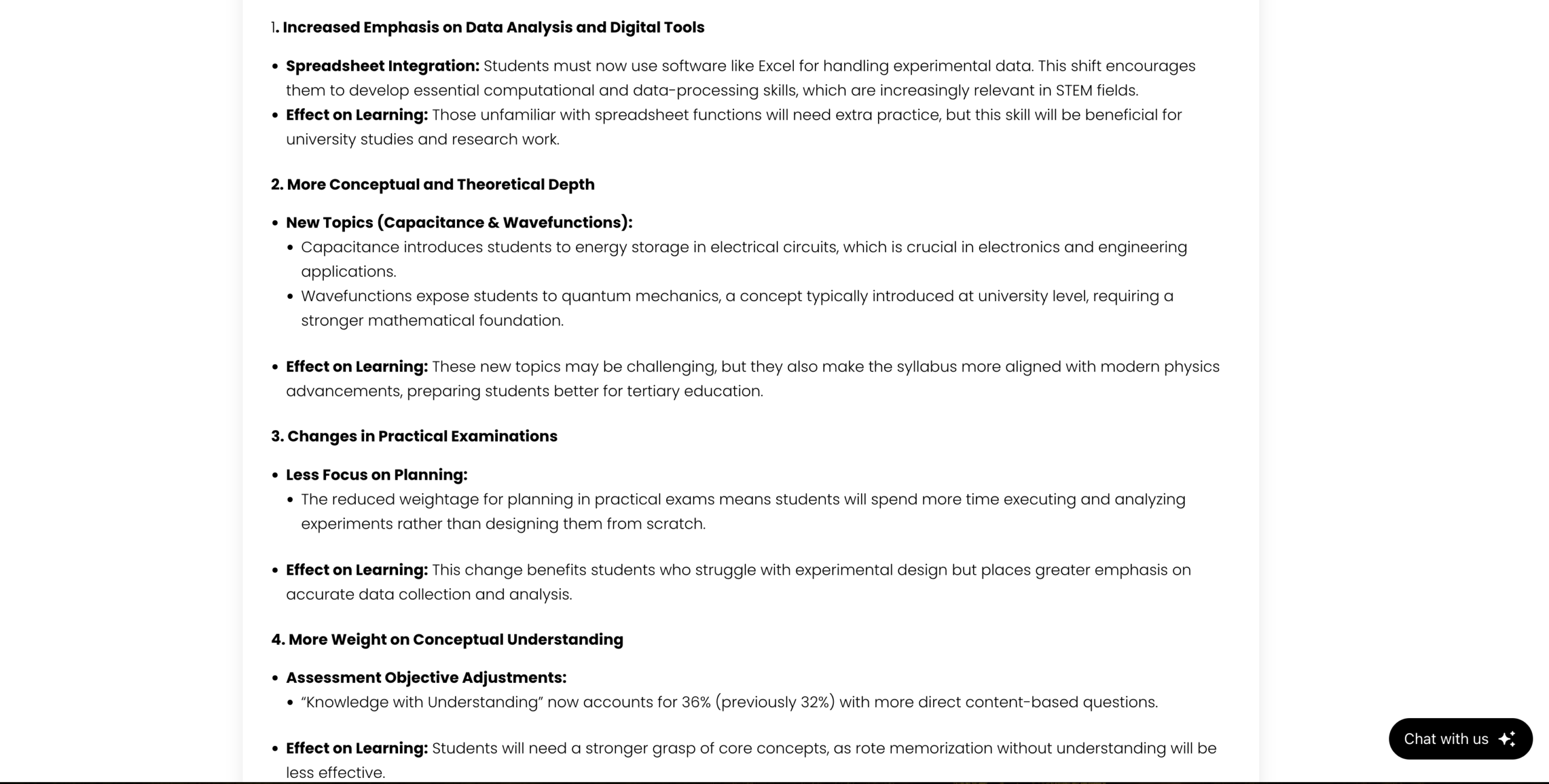
In recent years, Physics exam papers have become less predictable in structure and more demanding in reasoning.
Questions increasingly require students to apply familiar ideas in unfamiliar contexts, interpret data carefully, and justify conclusions using scientific language.
At O-Level, students are expected to explain phenomena clearly and relate calculations back to physical meaning.
At A-Level, especially H2 Physics, students must use spreadsheets and link multiple concepts within a single question and interpret experimental or data-based information with precision.
This means that repeating past-year questions alone is no longer sufficient preparation.
What “Success” in Physics Looks Like in 2026
Success with physics tuition
Success in 2026 Physics exams is less about speed and more about clarity of thinking. Students who perform well tend to show three consistent traits:
- They understand why formulas work, not just when to use them.
2. They can explain their reasoning step by step using correct scientific terms.
3. They are comfortable applying concepts across different topics and contexts.
Physics tuition that supports these outcomes focuses on thinking structure, not just answer accuracy.
Where Physics Tuition Makes the Biggest Impact Today
Physics tuition is most effective in 2026 when it addresses gaps created by changes in syllabus demand and assessment style. (This change in the syllabus and assessment styles are likely to continue from 2026 into 2027).
At the O-Level, tuition helps students move from formula-based answers to structured explanations that match marking schemes. At the A-Level, tuition helps students organise complex ideas, manage multi-step problems, and communicate reasoning clearly under time pressure.
The value lies not in extra exposure, but in guided interpretation and structured practice.
Why Generic Tuition Approaches Are Less Effective Now
Many tuition approaches still focus heavily on drilling standard question types. While practice is necessary, this approach alone often fails to prepare students for newer question styles that test interpretation and reasoning.
In 2026, students who rely solely on pattern recognition may struggle when questions are phrased differently or when familiar concepts are embedded in unfamiliar situations. Tuition that does not adapt to this reality risks adding workload without improving outcomes.
At Pivotphysics, effective Physics tuition places greater emphasis on:
- Breaking down unfamiliar questions with our 5 Step method
- Identifying which principles apply before calculating
- Master essential practical and lab skills
O-Level and A-Level Physics Require Different Support
Although both levels share core principles, the type of support students need differs.
At O-Level, tuition often focuses on building clarity in explanations, proper use of diagrams, and avoiding common reasoning errors. At A-Level, tuition shifts toward integrating concepts, handling data-based questions, and developing exam-ready scientific communication.
Recognising this difference is important. A one-size-fits-all approach rarely works across both levels.
Choosing Physics Tuition with 2026 in Mind
When considering Physics tuition in 2026, parents and students should look beyond the number of topics covered or the volume of practice questions completed. What matters more is whether the support helps students understand concepts clearly and apply them under exam conditions.
If you are in doubt ask the following questions:
- Does the tuition emphasise explanation and reasoning?
- Are students taught how to approach unfamiliar questions?
- Is there guidance for both written and practical components?
- Does the support evolve as exam demands increase?
Excel in Physics with PivotPhysics Tuition
PivotPhysics offers specialised Physics tuition for O-Level, A-Level H1/H2, and IP Physics students in Singapore.
With a proven track record, our lessons combine clear concept teaching, real-life applications, and exam-focused techniques to build a strong foundation and boost confidence in Physics.We also provide Physics Practical Lab Coaching aligned with SEAB standards to help students excel in their Paper 3 components.
👉 Contact us today to find out how PivotPhysics can support you or your child in achieving excellence in O-Level, A-Level, or IP Physics.