A Level results mark a major turning point for students completing Junior College or Millennia Institute in Singapore.
These results determine post secondary pathways such as university admissions, course choices, and in some cases alternative education routes.
Understanding when A Level results are released and what steps follow can help students and parents navigate this period more confidently.
When Do A Level Results Come Out
A Level results are typically released in mid February of the year following the examinations. For students who sat for the A Level examinations in 2025, results are expected to be released in February 2026, subject to official confirmation by the Ministry of Education and the Singapore Examinations and Assessment Board.
Students usually receive:
- A physical result slip from their school
- Digital access to results through official MOE or school platforms
The exact date is announced closer to February, so students are advised to follow official school communications and MOE announcements.
What Happens After A Level Results Are Released
Once A Level results are released, students move quickly into the next phase of applications and decision making. This stage is time sensitive and requires careful planning.
Key post result processes include:
- University applications to local autonomous universities
- Applications to overseas universities
- Appeals or reconsideration where applicable
- Review of alternative pathways if results differ from expectations
Understanding University Applications After A Levels
Local University Applications
For students applying to local universities, A Level results are used to determine eligibility for courses based on rank points and subject prerequisites. Competitive courses may require strong grades in specific subjects such as H2 Mathematics or H2 Physics.
Students should review:
- Course specific subject requirements
- Indicative grade profiles
- Additional assessments such as interviews or aptitude tests
Meeting minimum requirements does not guarantee admission, so careful course selection is important.
Overseas University Applications
Some students may have applied to overseas universities before receiving A Level results, while others apply after results are released. Requirements vary widely depending on the institution and country.
Students should pay attention to:
- Conditional offer requirements
- Grade conversion guidelines
- Submission deadlines for final results
Choosing Physics Related Pathways After A Levels
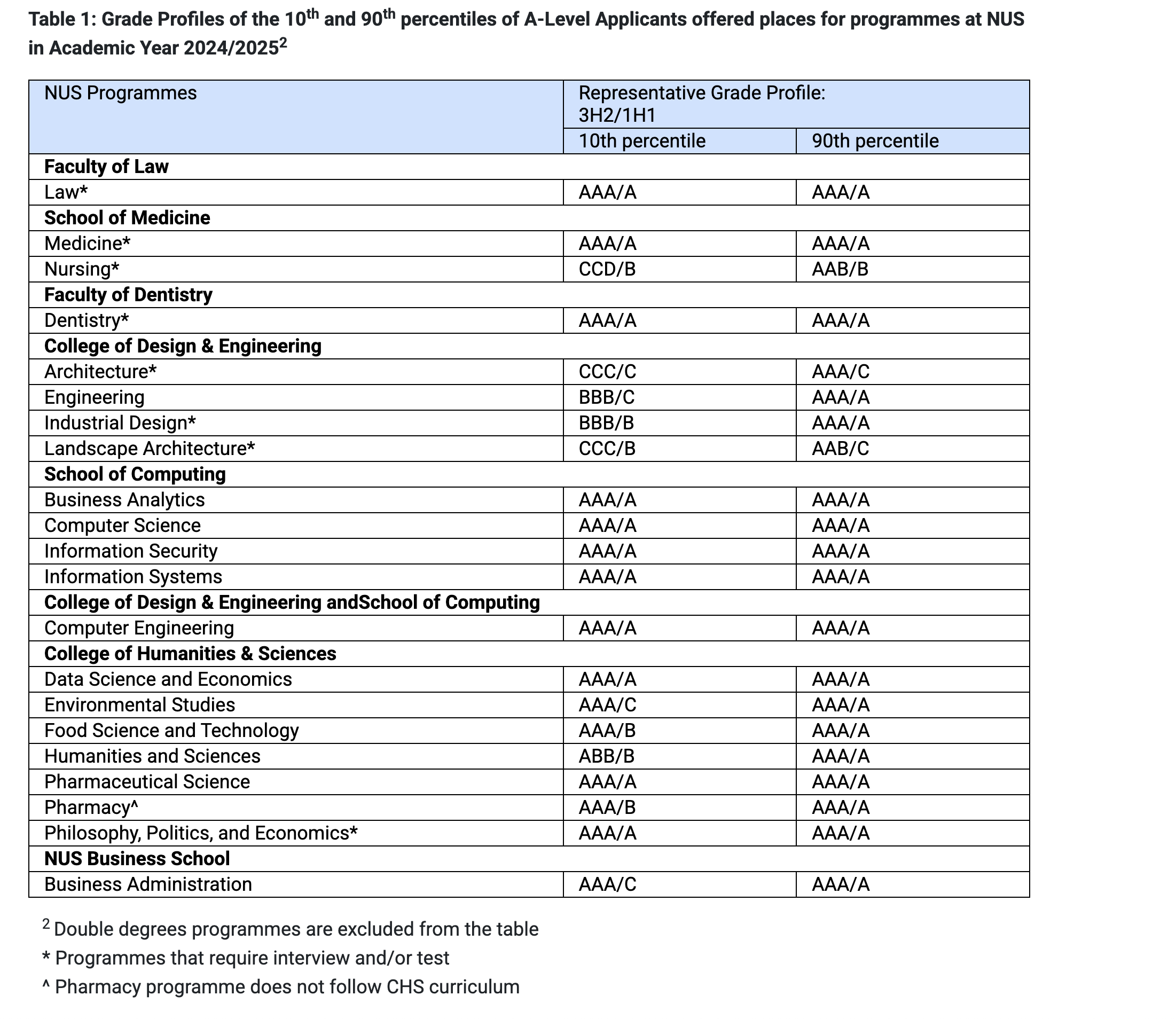
NUS Indicative Grade Profile
Source: NUS Indicative Grade Profile
Physics and STEM Courses at University
Students who have taken H2 Physics often consider courses in engineering, science, computing, or technology related fields. University Physics builds on H2 Physics concepts but requires stronger mathematical application and independent learning.
Students should consider whether they are comfortable with:
- Applying Physics concepts in unfamiliar contexts
- Handling abstract reasoning and problem solving
- Managing heavier academic workloads
Strong foundations at the A Level stage can ease the transition into these courses.
What If Results Are Not as Expected
Not all students receive the results they hoped for. This can be disappointing, but it does not mean options are closed.
Possible next steps include:
- Reviewing alternative degree programmes
- Considering foundation or bridging courses
- Exploring polytechnic or applied pathways
- Taking time to reassess academic strengths and interests.
*You may also consider retaking the A Levels if University is an integral part of the plan.
What Students and Parents Should Look Out For
During the post A Level period, it is important to:
- Understand application timelines clearly
- Check subject prerequisites carefully
- Consider long term goals rather than short term outcomes
- Seek academic or career guidance when uncertain
Open communication between parents and students can help manage expectations and reduce stress during this transition.
Excel in Physics with PivotPhysics Tuition
PivotPhysics offers specialised Physics tuition for O-Level, A-Level H1/H2, and IP Physics students in Singapore.
With a proven track record, our lessons combine clear concept teaching, real-life applications, and exam-focused techniques to build a strong foundation and boost confidence in Physics.We also provide Physics Practical Lab Coaching aligned with SEAB standards to help students excel in their Paper 3 components.
👉 Contact us today to find out how PivotPhysics can support you or your child in achieving excellence in O-Level, A-Level, or IP Physics.